Industries
insights
Infographics & Carousels
Visual explainers on the data and governance challenges most commonly blocking enterprise GenAI deployment.
The complexity of AI testing, particularly around unstructured data and privacy compliance, is difficult to communicate in prose alone. These infographics distil the core concepts into formats built for executive and cross-functional audiences.
Infographics

The GenAI Platform Alignment Map: Closing the Readiness Gap
Modern AI platforms provide the model capability and infrastructure to run GenAI at scale. But organisations are finding a critical bottleneck: they lack the high-fidelity unstructured data needed to test those models safely before deployment. This infographic maps the three-layer ecosystem required to close that gap, and shows why a dedicated data readiness layer sits between cloud infrastructure and production-ready AI deployment. Platforms run GenAI. Data Infusion makes it safe to test and evaluate.

The Testing Fallacy: Why GenAI Readiness Stalls
Most organisations approaching GenAI deployment assume their biggest challenge is the model. It is not. The bottleneck is the test data. Real customer data cannot be used, masking strips the contextual language signals that make data useful for GenAI evaluation, and manual creation breaks down at scale. This infographic breaks down the three most common approaches to unstructured test data, why each one fails, and what a dedicated readiness layer makes possible instead.

The Lab-to-Production Gap: Why GenAI Agents Fail When It Matters Most
Your GenAI agent passed every test in the lab. Then it met a real customer complaint, messy, ambiguous, and emotionally loaded, and failed. This is not a model problem. It is a data problem. The gap between lab-safe structured data and the unstructured reality of how people actually communicate is where most GenAI initiatives quietly break down. Masking strips the linguistic signals that matter. Real customer data cannot be used safely or legally. Manually created datasets do not scale. This infographic sets out the architecture of readiness, and the question every organisation should be asking before their GenAI goes live.

The GenAI Testing Paradox: 4 Strategic Blockers for Financial Services CIOs
In financial services, the assumption that a GenAI system is production-ready is often the most dangerous one in the room. Regulatory pressure from ASIC and APRA, unacceptable PII risk, testing constraints that produce linguistically uniform datasets, and boardroom exposure when real customer data cannot be ruled out: these four blockers are why so many AI initiatives that perform well in controlled evaluation fail when they meet real customer communication. This infographic sets out each blocker and what resolving them actually requires.
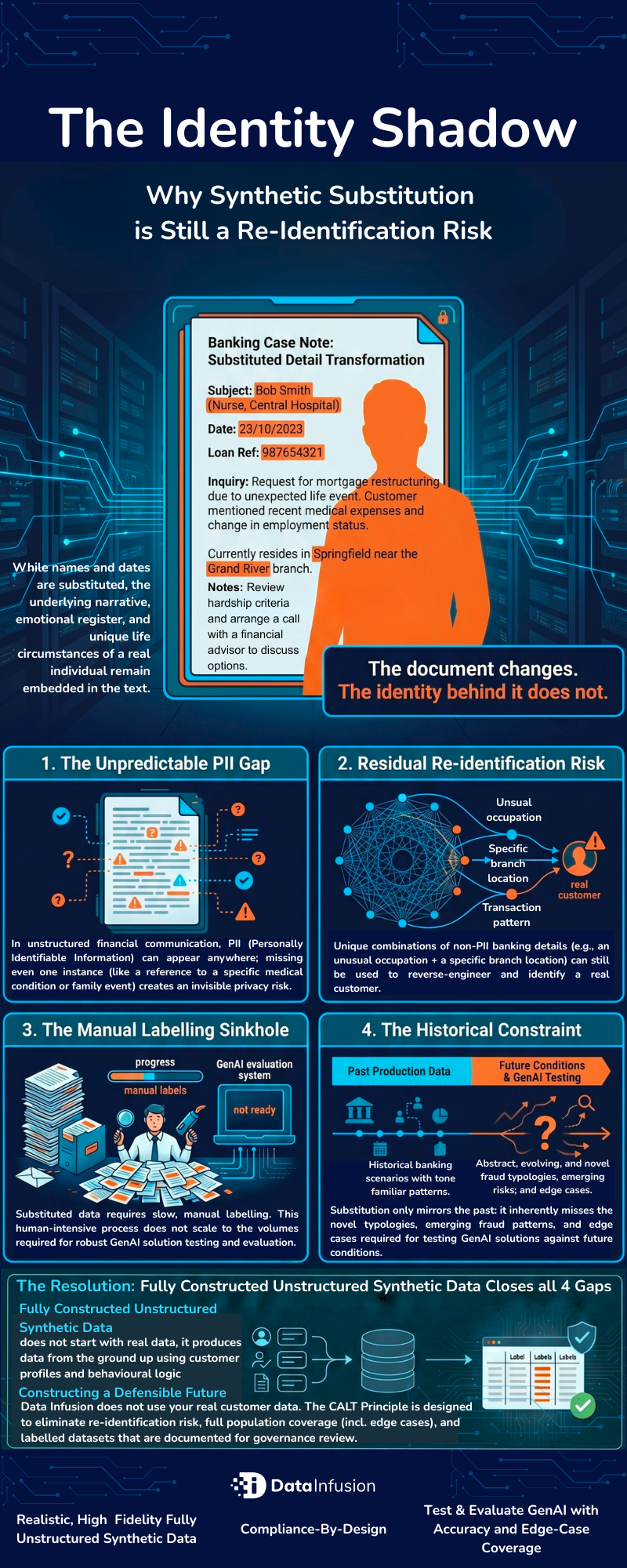
The Identity Shadow: Why Synthetic Substitution Is Still a Re-identification Risk
Synthetic substitution preserves what masking destroys: tone, context, behavioural nuance, and emotional register. That is precisely why it represents progress. It is also why it is not enough. The names change. The identity behind the document does not. Four gaps remain that substitution cannot fully close: re-identification risk, unpredictable PII, missing edge cases, and manual labelling at scale. This infographic breaks down all four in the context of unstructured data and the testing and evaluation of GenAI solutions.

Structured vs Unstructured Data
Most enterprises are still optimising the 20% of their data that is easiest to manage, not the 80% where the real value sits. Structured data handles reporting, dashboards, and traditional analytics well. But the hardest problems such as complaints, hardship, complex customer journeys, regulatory exposure, live in unstructured data. This infographic breaks down the difference between structured and unstructured data, and why unstructured data is where high-value GenAI use cases live. If your GenAI strategy only looks at structured data, you are optimising the wrong end of the problem.

The Clear Enterprise Blocker: GenAI Testing: The Hidden Data Barrier Blocking Deployment
The biggest blocker to enterprise GenAI is not the model, it is the data required to test it. Real customer data is off-limits for model testing: legally, ethically, and operationally. And even where it were permitted, it is scattered, inconsistent, unlabelled, and missing the edge-case scenarios needed to validate accuracy. That leaves most organisations unable to answer the question boards, risk teams, and regulators ask first: how do we know this GenAI solution is safe to deploy? This infographic breaks down the hidden test-data barrier preventing high-value GenAI from going live and why synthetic unstructured test data is now essential for accuracy, compliance, and enterprise confidence.

Why Masking Personal Information Is Not Enough for GenAI Testing
Masking personal information is widely treated as the safe answer for GenAI testing. For unstructured data, that assumption breaks down quickly. When language, context, and intent are altered by masking, models are no longer being tested against real-world conditions and privacy risk does not disappear, it becomes harder to see. This infographic outlines why masking alone is not sufficient for GenAI testing in regulated B2C environments, and why unstructured data requires a compliance-by-design approach built around synthetic data from the outset.

The AI Reliability Gap: Why Testing Agents is the Ultimate Challenge
AI agents operating in production encounter a testing challenge that conventional approaches cannot resolve. A December 2025 paper by Melissa Z. Pan et al. identified two findings with direct implications for any organisation deploying agents in regulated environments: determining AI agent reliability remains unsolved, and generating the gold-standard unstructured test data needed to measure it is described as “nearly infeasible.” This infographic maps the reliability gap - why it forms, what it costs organisations that do not close it, and what a rigorous, synthetic-data-led testing approach makes possible. Read alongside the Testing AI Agents thought leadership piece for the full analysis.
Carousels
Short-form visual content published by Data Infusion, designed for fast consumption across executive and technical audiences.

Production-Ready or Just Lab-Safe?
When GenAI agents are tested and evaluated only against predictable, structured datasets, they can appear production-ready in a controlled environment, then fail when they encounter the nuance, ambiguity, and complex behavioural signals of real customer interactions. In high-accountability environments, that failure translates directly into regulatory scrutiny, customer harm, and reputational damage. This carousel sets out why current testing approaches create a false sense of security, and the three questions every executive should be asking their technical teams before deployment.

Beyond Redaction: The Rise of Synthetic Substitution
Synthetic substitution was a meaningful step beyond redaction. But it is not the finish line. Enterprise teams building GenAI solutions on unstructured customer data have been operating with a false sense of security: the data looks right, but looking right is not the same as being safe or sufficient. This carousel breaks down exactly where synthetic substitution falls short across four critical dimensions, unpredictable PII it cannot find, re-identification risk it cannot eliminate, manual labelling it cannot scale, and historical constraints it cannot escape, and what the standard actually needs to be.

Is Your GenAI Test Data Trustworthy?
Most organisations operating in B2C environments cannot answer that question with confidence, not because the question is new, but because test data governance has not kept pace with GenAI adoption. This visual self-assessment identifies the blind spot Data Infusion sees repeatedly across financial services, retail, insurance, and government: the assumption that existing test data practices are sufficient for GenAI. Responsible GenAI starts upstream, with how test data is chosen, created, and governed.

Why GenAI Initiatives Stall Without Controlled Test Environments
Pilots look promising. Platforms are modern. Talent is strong. But when deployment decisions approach, confidence tightens and the friction almost always traces back to unstructured customer test data. This visual explains the structural readiness gap behind many stalled GenAI initiatives. Without controlled, synthetic-but-realistic unstructured test data, realism, and compliance remain in tension. If your systems were reviewed tomorrow by board, risk, or regulators - would your unstructured test data withstand scrutiny?
Explore related content across our Insights section

